 By
By - 310


Business
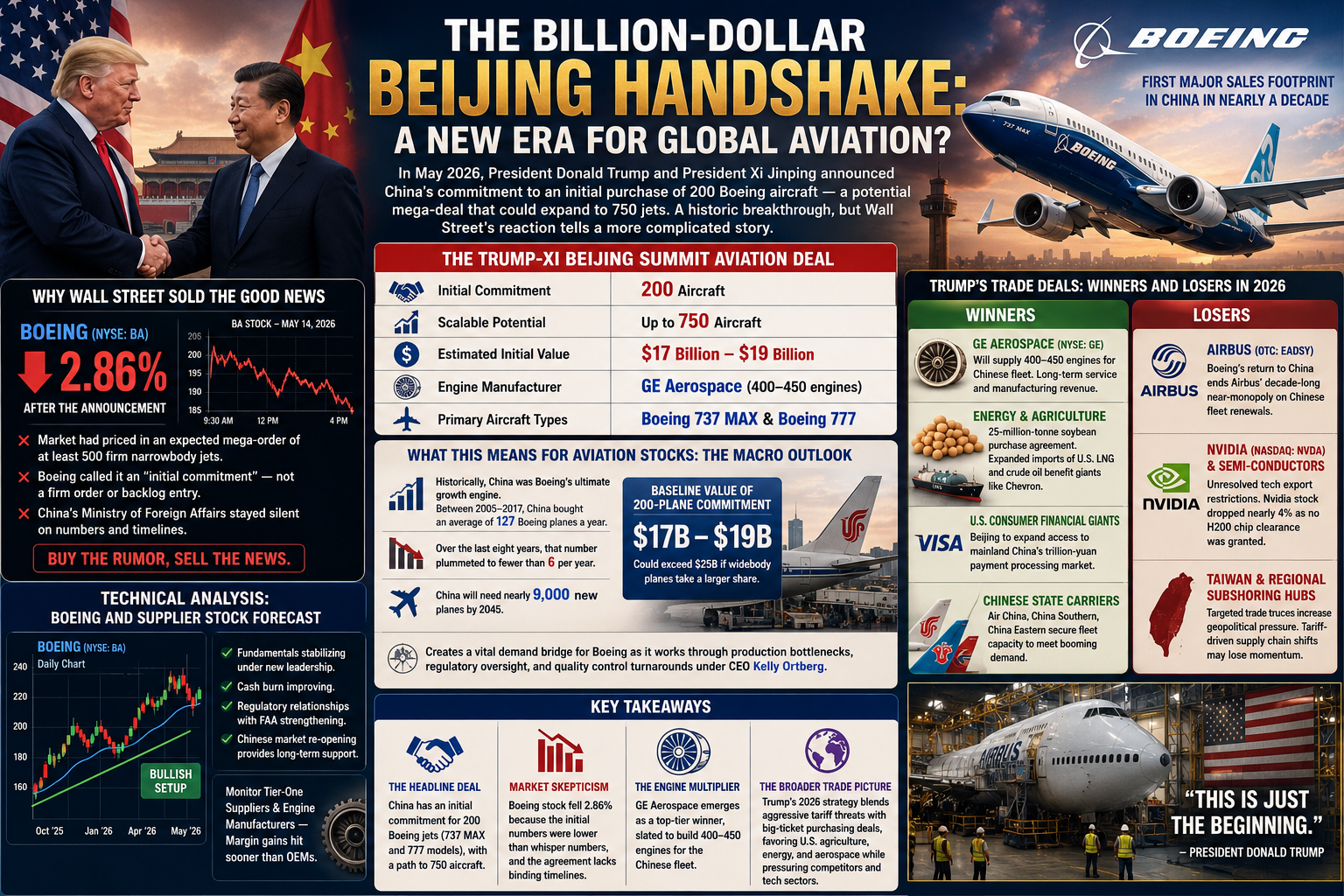
The Billion-Dollar Beijing Handshake: A New Era for Global Aviation? A dramatic geopolitical shift occurred in May 2026 at the high-stakes bilateral summit in Beijing. U.S. President Donald Trump announced that China has committed to an initial purchase of 200 Boeing aircraft. This tentative mega-deal could potentially expand to 750 jets if trade negotiations progress smoothly. For Chicago- and Arlington-based Boeing, this announcement marks a critical diplomatic breakthrough. It represents its first major sales footprint in the Chinese commercial aircraft market in nearly a decade. However, Wall Street’s reaction was unexpectedly cold. Despite the massive headline numbers, Boeing (NYSE: BA) shares dropped nearly 3% following the announcement. The market's skeptical response highlights the tension between political showmanship and the cold reality of financial markets. As the dust settles on the historic Trump-Xi summit, investors are trying to figure out what this means for aviation stocks. They are also parsing who the ultimate winners and losers will be under the administration's aggressive 2026 trade policies. The Anatomy of the 200-Jet Deal: Commitment vs. Firm Order To understand how this commercial aircraft market development impacts your investment portfolio, it is essential to separate political rhetoric from binding corporate contracts. President Trump told reporters aboard Air Force One that Chinese President Xi Jinping committed to an initial batch of 200 Boeing planes. The order includes a mix of narrowbody Boeing 737 MAX models and widebody Boeing 777 aircraft, all powered by GE Aerospace engines. Trump added that the total transaction could eventually scale up to 750 aircraft if Beijing "does a good job" fulfilling its side of the economic ledger. +---------------------------------------------------------------+ | THE TRUMP-XI BEIJING SUMMIT AVIATION DEAL | +--------------------------+------------------------------------+ | Initial Commitment | 200 Aircraft | +--------------------------+------------------------------------+ | Scalable Potential | Up to 750 Aircraft | +--------------------------+------------------------------------+ | Estimated Initial Value | $17 Billion – $19 Billion | +--------------------------+------------------------------------+ | Engine Manufacturer | GE Aerospace (400–450 engines) | +--------------------------+------------------------------------+ | Primary Aircraft Types | Boeing 737 MAX & Boeing 777 | +--------------------------+------------------------------------+ Why Wall Street Sold the Good News If the news is so historic, why did Boeing stock slide? Aerospace analysts at institutional firms like Jefferies revealed that the market had priced in an expected mega-order of at least 500 firm narrowbody jets. Furthermore, Boeing's corporate communications team referred to the agreement as an "initial commitment" rather than a finalized order. In aerospace manufacturing sector terms, a commitment is a preliminary, non-binding agreement that does not yet enter official corporate backlog data. Compounding investor anxiety, China's Ministry of Foreign Affairs remained characteristically quiet, declining to provide specific numbers or timelines. This discrepancy triggered a classic "buy the rumor, sell the news" reaction on Wall Street. What This Means for Aviation Stocks: The Macro Outlook For the broader global aviation industry, China's re-entry into the American aerospace ecosystem signals a monumental, albeit cautious, structural shift. Historically, China was Boeing's ultimate growth engine. Prior to the 2019 grounding of the 737 MAX and the subsequent freeze in US-China trade relations, roughly one-third of all Boeing narrowbody deliveries were destined for Chinese carriers. Between 2005 and 2017, China bought an average of 127 Boeing planes a year. Over the last eight years, that number plummeted to fewer than six per year. Aviation advisory firm IBA estimates the baseline value of this 200-plane commitment at $17 billion to $19 billion. If widebody planes take up a larger percentage of the order, that valuation could easily clear $25 billion. For investors analyzing what this means for aviation stocks, the true value lies not in immediate quarterly cash flows, but in long-term manufacturing predictability. The deal creates a vital demand bridge for Boeing as it continues to work through production bottlenecks, rigorous regulatory oversight, and quality control turnarounds under CEO Kelly Ortberg. Trump's Trade Deals: Winners and Losers in 2026 The commercial aircraft market was the headline story of the summit, but Trump’s broader "reciprocal tariff" policies and bilateral negotiations are reshaping multiple sectors. The economic landscape of 2026 shows clear winners and losers. The Winners GE Aerospace (NYSE: GE): Perhaps the most clear-cut winner of the Beijing summit. President Trump explicitly noted that GE would supply between 400 and 450 engines to power the newly committed Chinese fleet, providing long-term service and manufacturing revenue. Traditional Energy and Agriculture: Alongside the aviation framework, U.S. Trade Representative Jamieson Greer confirmed a 25-million-tonne soybean purchase agreement. Additionally, China committed to expanding its imports of U.S. liquefied natural gas (LNG) and crude oil, benefiting major players like Chevron. U.S. Consumer Financial Giants: Corporate executives like Visa CEO Ryan McInerney accompanied the presidential delegation. The administration successfully pressured Beijing to expand access to mainland China’s trillion-yuan payment processing market. Chinese State Carriers: Air China, China Southern, and China Eastern secure necessary fleet capacity. This helps them meet booming domestic travel demands without relying solely on European backlogs or the slowly scaling domestic COMAC C919 program. The Losers Airbus (OTC: EADSY): The European aerospace giant has capitalized heavily on Boeing's decade-long absence from China. This fresh U.S. trade pressure signals that Airbus will no longer enjoy an uncontested monopoly over Chinese fleet renewals. Nvidia (NASDAQ: NVDA) & Semi-Conductors: Despite CEO Jensen Huang flying to Beijing on Air Force One, markets reacted poorly to unresolved tech export restrictions. Nvidia stock dropped nearly 4% as the summit failed to yield formal Chinese regulatory approval for the high-end H200 chip clearance. Taiwan and Regional Subshoring Hubs: As Washington and Beijing move toward targeted tactical trade truces, regional economies like Taiwan face increased geopolitical pressures. Companies that benefited from tariff-driven supply chain diversification may face headwinds as trade shifts back toward integrated superpowers. Technical Analysis: Boeing and Supplier Stock Forecast From a pure trading perspective, the immediate downside in aviation stocks presents a compelling entry point for value-oriented investors. Boeing's underlying fundamentals are steadily stabilizing under new leadership. The company has focused on reducing cash burn and repairing its fractured regulatory relationships with the FAA. The re-opening of the Chinese market—which Boeing and Airbus project will require nearly 9,000 new planes by 2045—provides strong support for the aerospace sector's valuation. Savvy investors should monitor the aerospace tier-one supply chain. Component suppliers and engine manufacturers often realize margin gains much faster than original equipment manufacturers (OEMs) facing labor bottlenecks. Key Takeaways The Headline Deal: China has signed an initial commitment for 200 Boeing jets (737 MAX and 777 models), with a political framework to expand up to 750 aircraft. Market Skepticism: Boeing stock fell 2.86% immediately after the news because the initial numbers were lower than whisper numbers, and the agreement lacks binding contractual timelines. The Engine Multiplier: GE Aerospace emerges as a top-tier winner, slated to build 400 to 450 engines for the Chinese fleet. The Broader Trade Picture: Trump's 2026 trade strategy blends aggressive tariff threats with big-ticket corporate purchasing agreements, favoring U.S. agriculture, energy, and aerospace while putting pressure on European competitors and tech sectors. FAQs Why did Boeing stock drop after China committed to buying 200 planes? Investors sold the news because institutional analysts had expected a firmer agreement for 500 or more planes. Additionally, Boeing categorized the deal as a non-binding "initial commitment" rather than a firm order, leaving room for future cancellations or adjustments. What types of planes are included in the China-Boeing deal? According to statements from President Trump, the aircraft package consists of a mix of narrowbody Boeing 737 MAX models for domestic routes and widebody Boeing 777 jets for long-haul international flights. Who benefits most from Trump's 2026 trade deals? The immediate winners include GE Aerospace, U.S. agricultural exporters (specifically soybean producers), energy companies supplying LNG, and domestic financial firms like Visa seeking entry into Chinese payment networks. Will this deal hurt Airbus's market share? Yes, structurally. Airbus had taken over the majority of the Chinese aviation market during Boeing’s decade-long lockout. This agreement re-opens the door for American competition, stopping Airbus from completely dominating Chinese fleet procurement. Is the 750-plane order guaranteed? No. The 750-aircraft figure is a long-term potential ceiling mentioned by the Trump administration. It depends heavily on continued stability in US-China trade relations and the formal conversion of initial commitments into firm, legally binding contracts.