 By
By - 176


Finance
The Geopolitical Tax on Growth: United Nations Lowers Economic Forecasts
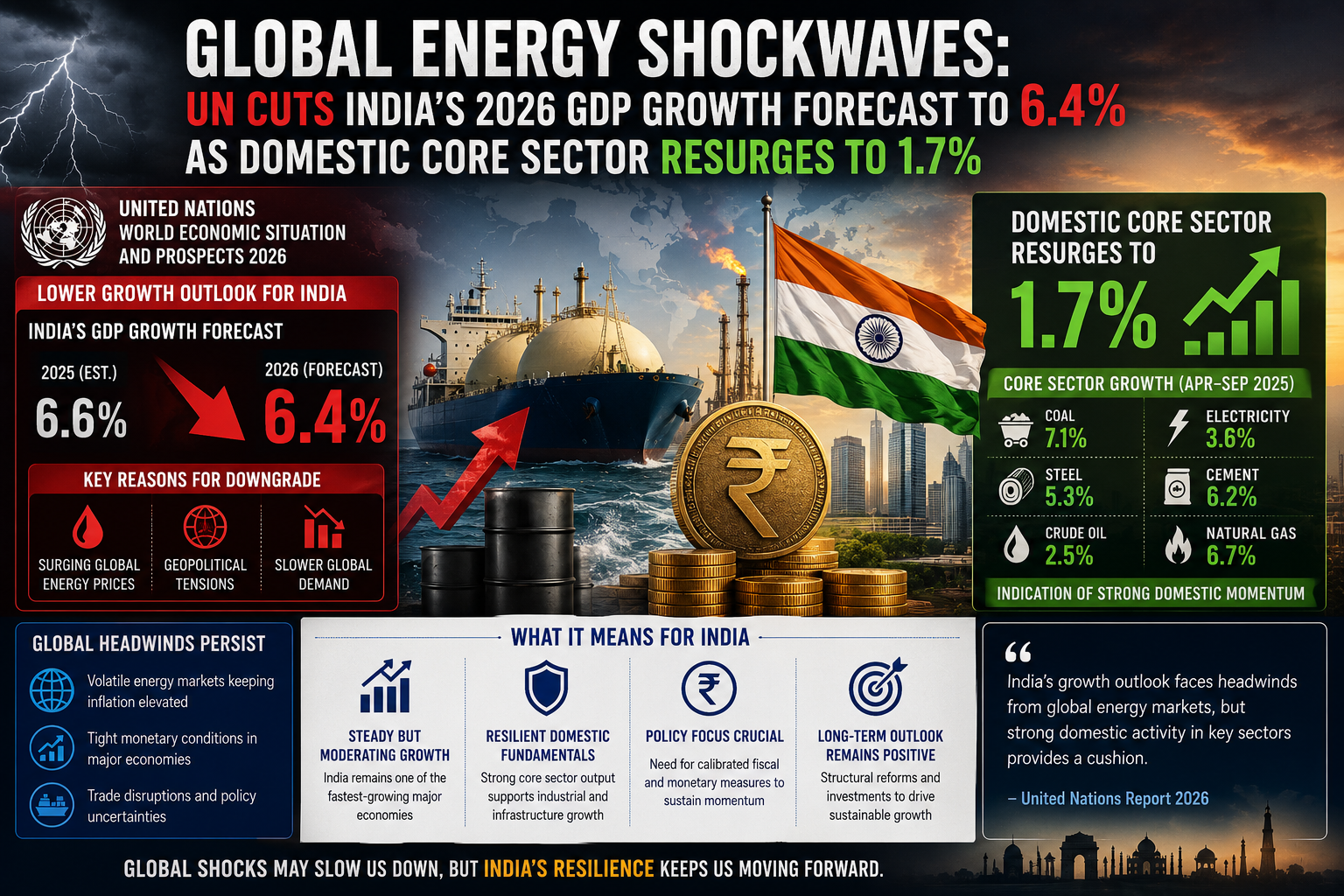
The ongoing macroeconomic friction in West Asia has officially registered its drag on the world's fastest-growing major economy. On Wednesday, May 20, 2026, the United Nations Department of Economic and Social Affairs (UN DESA) officially revised its economic growth forecast for India downward, clipping its 2026 GDP projection to 6.4 percent from its previous estimate of 6.6 percent. Leading global economists noted that while India’s underlying structural drivers—such as robust local consumer demand, aggressive public infrastructure investment, and thriving services exports—remain fundamentally intact, the country is simply "not immune" to severe external supply-chain shocks. The UN report emphasized that the persistent conflict has delivered a dual blow to emerging markets, simultaneously slowing cross-border industrial momentum while reigniting intense headline inflation risks due to soaring energy import expenses and ballooning maritime freight logistics.
HSBC Flashes Warning Flags Over High Oil Prices and Currency Devaluation
Reinforcing this cautious global stance, multinational banking giant HSBC released a parallel economic report on May 20, projecting an even softer growth trajectory for the upcoming fiscal cycle. Chief India Economist Pranjul Bhandari flagged that higher fuel costs are actively compressing household purchasing power and weighing on corporate margins, estimating that India's GDP growth could moderate further to around 6 percent in FY27 from the 7.5 percent expansion recorded in FY26. Operating under the assumption that crude oil benchmarks will hover near a high average of $95 per barrel, HSBC expects consumer inflation to average a steep 5.6 percent, potentially breaching the Reserve Bank of India’s (RBI) 6 percent tolerance threshold for multiple months later this year. This energy crunch has severely widened the nation's balance of payments deficit toward a projected $65 billion, applying unprecedented depreciation pressure on the Indian Rupee, which slid further to settle near historical lows.
Industrial Resilience: Core Sectors Stage an Upward Counter-Offensive
Despite the tightening international environment, India’s domestic industrial engine delivered a highly reassuring and counter-cyclical surprise. According to official data released on May 20 by the Ministry of Commerce and Industry, activity across the nation's eight infrastructure core sectors quickened marginally to 1.7 percent in April 2026, up from a revised 1.2 percent in March. In a clear signal that domestic construction, real estate, and public work infrastructure projects are picking up steam, the cement sector surged to a three-month high of 9.4 percent growth. Similarly, the steel sector maintained robust operational health at 6.2 percent, while electricity generation accelerated to 4.1 percent. While domestic crude oil and natural gas production remained locked in contraction due to global supply limitations, the major upward revisions of previous manufacturing figures demonstrate that India possesses a resilient domestic cushion to absorb localized shocks before its economic inventories run dry.
Navigating the Fiscal Balance: Calibrated Monetary Policy Ahead
Looking forward, the dual reality of robust internal infrastructure demand and mounting external import inflation places Indian policymakers on a delicate economic tightrope. Rather than executing aggressive, knee-jerk monetary tightening that could choke off local business investments, experts predict the RBI will take a highly measured, calibrated stance, likely implementing only a couple of targeted interest rate adjustments in the latter half of the fiscal cycle to guard currency stability. To shield the currency further and manage local liquidity, the central bank has proactively announced a massive $5 billion dollar-rupee swap auction scheduled for late May. Ultimately, as the global economy transforms, the business enterprises that survive and thrive will be those that aggressively optimize internal supply chains, hedge against volatile fuel constraints, and leverage advanced technological infrastructure to drive structural productivity.