 By
By - 302


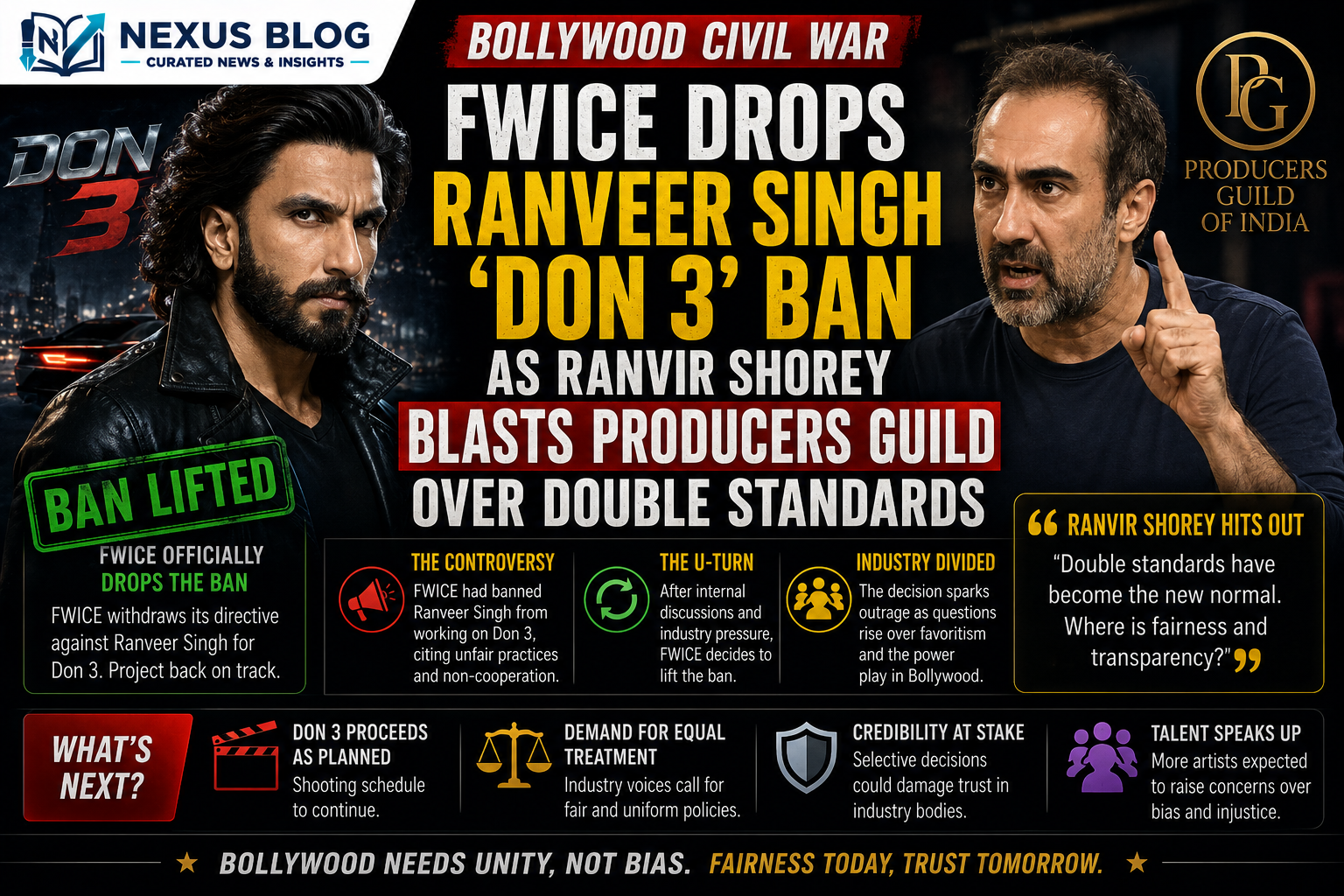
FWICE Drops Ranveer Singh Don 3 Ban as Ranvir Shorey Blasts Producers Guild Over Double Standards
Entertainment
The volatile corporate standoff gripping the Hindi film industry has taken a massive, highly dramatic turn this Thursday, June 4, 2026, permanently shifting the power dynamics between Bollywood’s elite talent and its structural trade unions. In a packed press conference in Mumbai, the Federation of Western India Cine Employees (FWICE) officially announced the immediate revocation of its controversial "non-cooperation directive" against superstar Ranveer Singh. The initial punitive order was issued after director Farhan Akhtar and producer Ritesh Sidhwani of Excel Entertainment lodged a formal complaint, alleging a staggering ?45 crore loss following Ranveer's abrupt, last-minute exit from the highly anticipated action reboot Don 3. Industry insiders reveal that the actor's departure closely coincided with his recent historical box-office triumph Dhurandhar, which shattered records by crossing the ?500-crore milestone and drastically altered his market equity. While FWICE President B.N. Tiwari and Chief Advisor Ashoke Pandit vehemently denied caving under the pressure of the legal notice served by Ranveer's powerhouse legal team, they conceded that the "ban" was lifted following urgent, high-level mediation requests from aligned industry bodies, including the Cine and TV Artistes Association (CINTAA) and the Indian Motion Picture Producers' Association (IMPPA), to safeguard the broader macroeconomic health of the film ecosystem.
However, the fragile administrative truce was instantly shattered as the Producers Guild of India stepped into the crossfire, releasing a fiercely worded public statement warning against a growing, highly disruptive trend of talent backing out of advanced commitments at the eleventh hour. While the Guild’s memorandum strategically avoided naming Ranveer Singh directly, it openly referenced formal complaints from major production houses—including Excel Entertainment and Panorama Studios, the latter reeling from Akshaye Khanna's unexpected departure from the Ajay Devgn-starrer Drishyam 3 just days before principal photography. The Guild argued that these abrupt walkouts cause severe financial hemorrhaging, tarnish the global brand equity of major cinematic franchises, and directly jeopardize the livelihoods of hundreds of daily-wage technicians and background crew members. This corporate finger-pointing immediately triggered an explosive, highly polarized online counter-offensive from veteran actor Ranvir Shorey, who took to social media to aggressively turn the spotlight back onto the predatory practices of powerful studio executives, effectively transforming a localized contract dispute into an all-out philosophical war regarding labor rights in modern cinema.
                  THE SHOWDOWN: LABOR VS. CAPITAL IN BOLLYWOOD

   [ STUDIO EXECUTIVES & PRODUCERS ]       ?       [ WORKING ACTORS & TECHNICIANS ]
                                           ?
   • Face massive pre-production losses     ?       • Suffer from unilateral cancellations
   • Suffer structural timeline damage     ?       • Receive zero holding/delay fees
   • Demand strict contract compliance     ?       • Demand mutual professional respect
Reacting directly to the Producers Guild's warning, Ranvir Shorey delivered a blunt reality check that resonated deeply across the digital landscape, writing, "You will not believe how many times producers cancel/delay projects unilaterally without any mention of compensation for the losses to an actor." When defensive internet users pushed back, arguing that corporate producers assume far greater financial risks and frequently end up bankrupt due to actors stalling dates, Shorey was quick to draw a sharp, uncompromising line between the industry's bulletproof elite and its everyday working class. "You are not talking about actors. Those are 'stars'!" Shorey shot back, highlighting that while A-list box-office magnets navigate the industry with immense leverage, the vast majority of working performers are treated as entirely disposable line items. He asserted that independent actors routinely lock their schedules for months, turning down alternative employment opportunities, only to have producers abruptly shelve or indefinitely postpone films without a single rupee of contractual compensation or professional courtesy.
"I totally see the argument that a company will tend to have more at stake, but my point is that workers deserve to be treated with respect and sensitivity too." — Ranvir Shorey via X (formerly Twitter)
As June 2026 unfolds, this escalating civil war underscores a profound structural crisis that Bollywood must urgently resolve if it hopes to maintain institutional stability. The Don 3 and Drishyam 3 fallouts have exposed a massive regulatory vacuum in how personal commitments, shifting market dynamics, and corporate liabilities are codified in entertainment contracts. While the Producers Guild prepares to hold fresh internal discussions in the coming weeks to establish more rigid, legally enforceable protocols to protect producers from sudden talent abandonment, the working-class creative fraternity is demanding reciprocal safeguards against unilateral studio delays. Furthermore, external frictions continue to mount; during the crossfire, Ashoke Pandit publicly demanded an apology from filmmaker Ram Gopal Varma for using abusive language against the federation, while counter-allegations surfaced claiming Varma owes over ?1 crore to workers dating back to 2017. With both sides dug firmly into their ideological trenches, the final outcome of the Guild's upcoming mediation sessions will not only dictate whether Ranveer Singh's dispute heads to a formal court of law, but will permanently redefine the ethical boundaries, contractual accountability, and professional respect shared between corporate capital and creative labor in the Indian film industry.