 By
By - 372


Tech Innovations
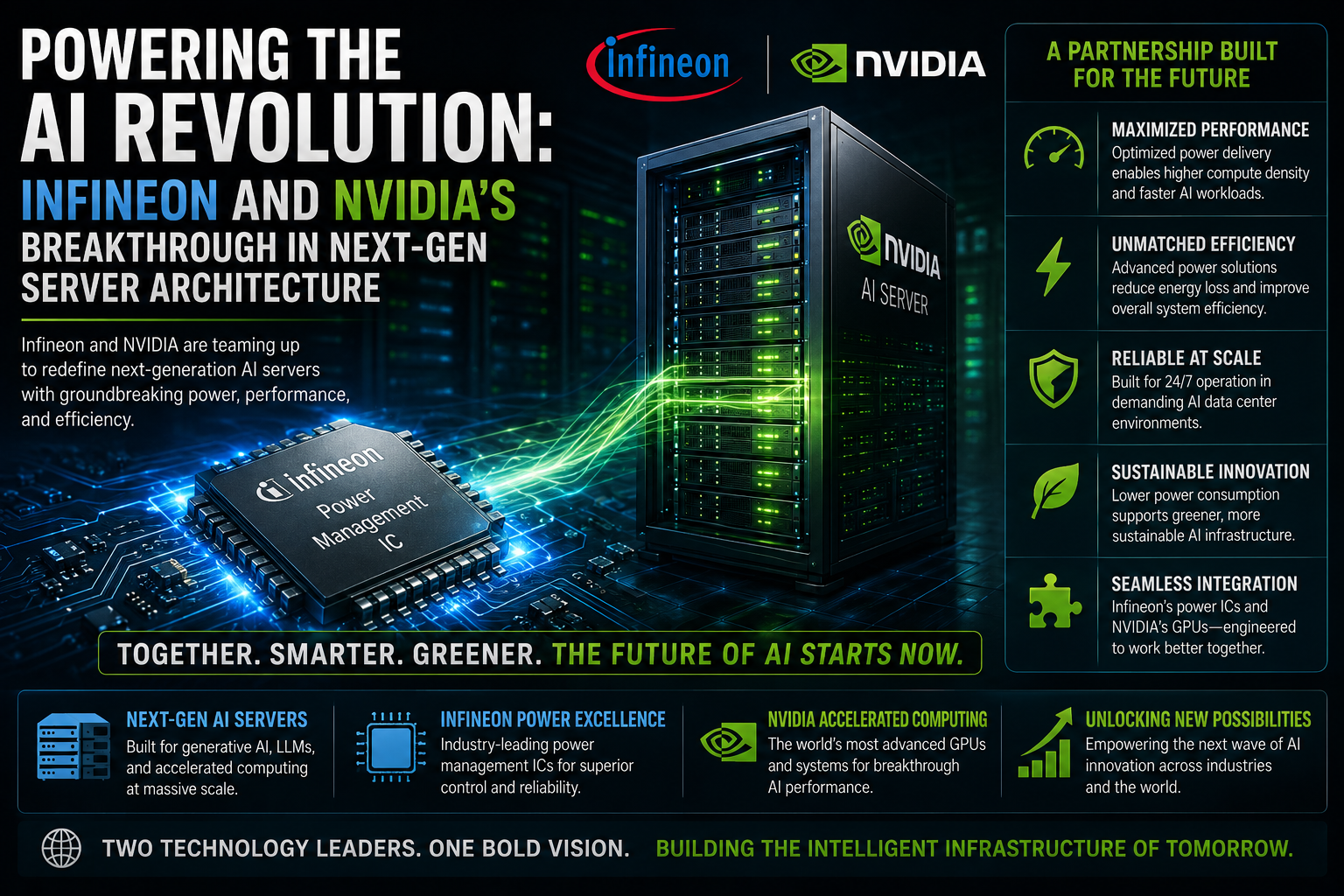
As the artificial intelligence landscape transitions from experimental software applications to the foundational backbone of the global digital economy, the most pressing bottleneck has shifted from coding algorithms to powering physical infrastructure. On May 29, 2026, a groundbreaking technological innovation took center stage when Infineon Technologies officially announced its strategic integration into NVIDIA's highly anticipated MGX™ AI Factory ecosystem. This landmark collaboration is specifically designed to radically transform the power delivery architecture for next-generation AI server racks, addressing a critical crisis facing the modern tech industry: the unsustainable energy consumption of massive data centers. As advanced AI models—such as multimodal systems and autonomous agentic AI—continue to grow exponentially in sheer size and computational complexity, traditional data centers are struggling to deliver the necessary performance within existing physical, power, and thermal constraints. By joining forces, NVIDIA and Infineon are redefining power delivery systems from the primary utility grid directly down to the processor core. Their combined efforts are accelerating the industry-wide transition toward a full-scale 800 VDC (Volts Direct Current) power architecture, an open and modular framework engineered explicitly for the demanding era of agentic AI. This technological leap allows existing AI facilities to dramatically scale their compute performance and power density, creating a crucial, sustainable upgrade path that prevents current infrastructure from becoming instantly obsolete in the face of tomorrow's intensive workloads.
The core of this new technology innovation lies in the deployment of advanced semiconductor materials that vastly outperform traditional silicon-based power components. Infineon brings to the table its deep, specialized expertise in power conversion, heavily leveraging cutting-edge Gallium Nitride (GaN) and Silicon Carbide (SiC) technologies. By utilizing GaN technology at switching frequencies approaching an unprecedented 1 MHz, engineers can now build ultra-compact bus converters that operate at industry-leading efficiency levels previously thought impossible. Furthermore, the integration of Infineon’s proprietary SiC JFET technology alongside dedicated control integrated circuits creates a perfect synergy for advanced protection and native hot-swap functionality within the 800 VDC environment. What this means in practical terms is that power conversion stages are significantly reduced, and pure DC power is delivered much closer to the actual server racks. In legacy data centers, multiple stages of alternating current (AC) to direct current (DC) conversions result in massive energy loss, typically dissipated as excess heat which in turn requires even more energy to cool. The new MGX-compatible power racks bypass these inefficiencies, significantly enhancing power distribution across the entire data center floor. This simplifies the physical infrastructure, supports incredibly high-density AI deployments, and drastically reduces the overall carbon footprint of operating advanced artificial intelligence models.
This strategic hardware innovation perfectly aligns with the broader, defining technology trends of 2026, specifically the global push toward "Sustainable and Green Computing" alongside the evolution of "Cloud 3.0." As we navigate through the year, the technology sector has realized that software innovation cannot outpace its hardware foundation. The energy demand for data centers has become a central focus for both tech giants and government regulators. NVIDIA's hybrid power architecture, augmented by Infineon's power management solutions, allows enterprises to protect their current, multi-million-dollar infrastructure investments while preparing their facilities for future, hyper-dense workloads without waiting to construct entirely new, full-scale 800V DC AI factories from the ground up. This modularity is the essence of Cloud 3.0—a diversified ecosystem where hybrid, private, and sovereign architectures must scale securely and sustainably. Rather than treating the cloud as a passive infrastructure layer, these innovations transform data centers into active enablers of AI-driven architectures. By lowering power waste and optimizing cooling requirements, companies are not only drastically reducing operational costs but are also meeting strict new international environmental regulations designed to curb the ecological impact of the global AI arms race.
Ultimately, the May 2026 partnership between Infineon and NVIDIA signals a profound maturation in the technology industry; we have officially entered the era where the physical realities of hardware dictate the boundaries of software imagination. The focus has decisively shifted from mere digital experimentation to structural rebuilding. As artificial intelligence continues to eat software—transitioning from traditional manual coding to intent-driven, self-assembling systems—the underlying hardware must achieve unparalleled levels of resilience, efficiency, and scale. This breakthrough in 800 VDC power delivery architecture is more than just an incremental hardware update; it is the fundamental technological innovation required to sustain the next decade of human progress. For enterprise leaders, data center operators, and technology investors, this development serves as a clear indicator that the most valuable innovations of late 2026 are those that solve complex physical bottlenecks. As the global economy becomes inextricably linked to AI computing power, advancements in semiconductor materials, energy distribution, and green infrastructure will continue to be the most critical and highly prized assets in the technology sector.