 By
By - 489


Sports
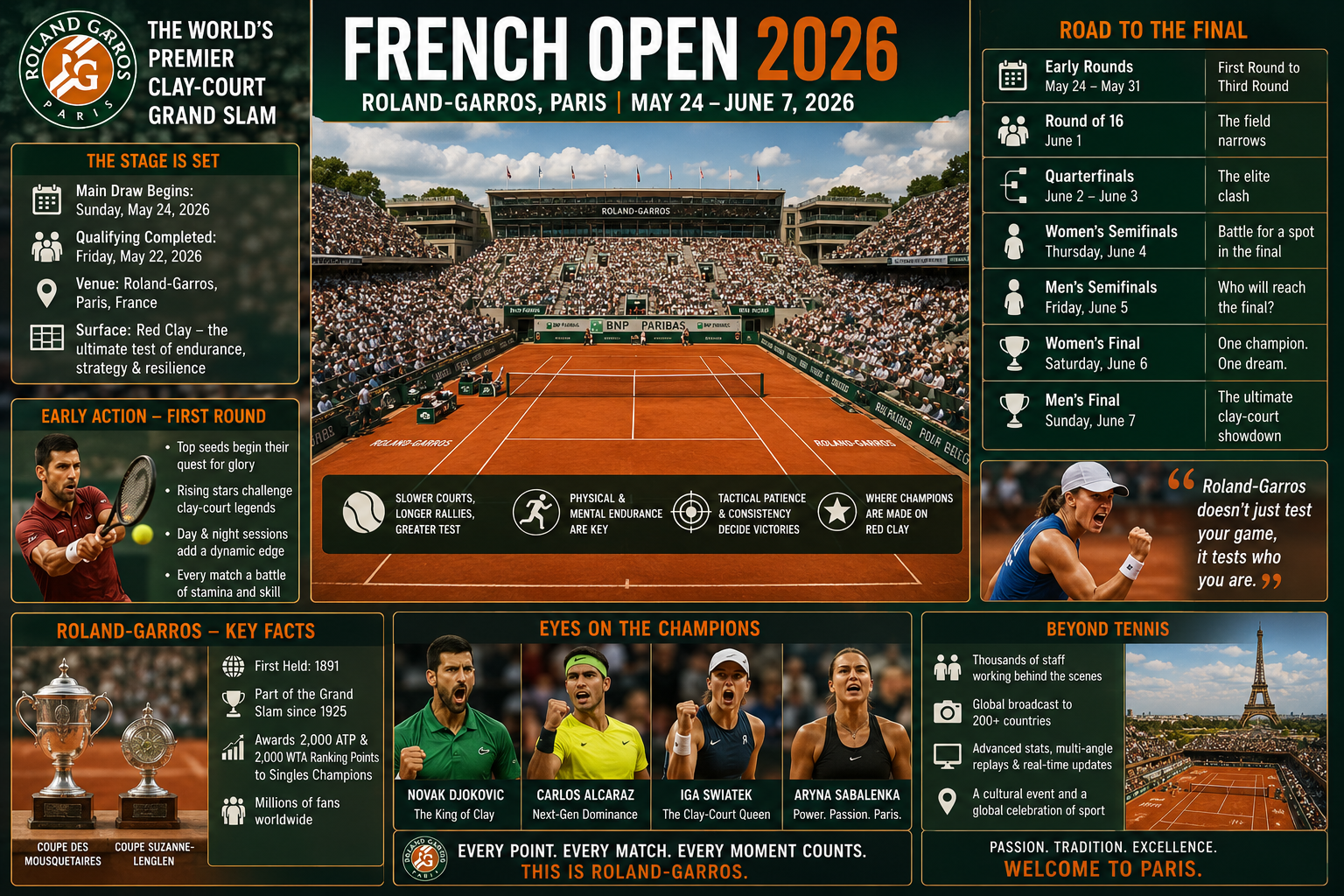
The premier event of the European clay-court season, the 2026 French Open, officially commenced its main draw on Sunday, May 24, transforming the historic grounds of Roland-Garros into the focal point of the global sports world. Following a highly competitive qualifying week that concluded on May 22, the top-ranked professionals in both men's and women's tennis have descended upon Paris to vie for one of the sport's most coveted Grand Slam titles. The tournament, renowned for its physically demanding red clay courts, requires a unique blend of endurance, tactical patience, and specialized movement, making it arguably the most grueling major championship on the professional circuit. As the first-round matches extended into Monday, May 25, the atmosphere at Court Philippe-Chatrier and Court Suzanne-Lenglen was electric, with capacity crowds eager to witness the opening salvos of the fortnight. For the athletes, the opening days are crucial for finding their rhythm on the slippery surface, adjusting to the variable Parisian spring weather, and establishing a dominant presence in their respective brackets. The culmination of months of rigorous preparation on the European clay circuit is now on full display, setting the stage for two weeks of compelling, high-stakes competition.
The early stages of this year's French Open are already delivering the intense rallies and dramatic momentum shifts characteristic of top-tier clay-court tennis. The men's and women's singles first-round matchups have highlighted the perpetual tension between seasoned baseline specialists and aggressive all-court players attempting to dictate play on a surface that naturally neutralizes power. Throughout the opening sessions on Sunday and Monday, competitors have had to navigate not only their opponents but also the distinct environmental factors of Roland-Garros. The heavy balls and slower court speeds demand extended rallies, placing a premium on peak physical conditioning and mental fortitude. Early action has seen several highly anticipated clashes, with rising stars eager to prove their mettle against established veterans who possess a historical pedigree on dirt. Observers are paying close attention to how the leading seeds manage their physical output during these initial rounds, as conserving energy is often a critical factor for those harboring deep tournament aspirations. Additionally, the integration of both day and evening sessions has introduced a dynamic element to the schedule, with the cooler night air subtly altering the pace and bounce of the court. As the remaining first-round fixtures conclude and the draw transitions into the second round later this week, the field will inevitably narrow, separating true title contenders from the rest of the pack in what promises to be an unpredictable and highly entertaining fortnight of world-class tennis.
Looking ahead, the meticulous scheduling of the 2026 French Open guarantees a steady crescendo of competitive intensity leading up to the championship weekend. According to the official tournament itinerary, the early rounds will proceed through the end of the first week, featuring a packed slate of singles, doubles, and mixed doubles action. The critical juncture of the tournament will arrive with the quarterfinals scheduled for Tuesday, June 2, and Wednesday, June 3, where the surviving elite will clash for a spot in the final four. The women's singles semifinals will take center stage on Thursday, June 4, followed by the men's singles semifinals on Friday, June 5. The event will reach its ultimate climax over the championship weekend, with the women's singles final slated for Saturday, June 6, and the men's singles final drawing the fortnight to a close on Sunday, June 7. Beyond the immediate glory of lifting the Coupe des Mousquetaires or the Coupe Suzanne-Lenglen, the results at Roland-Garros carry significant implications for the global tennis landscape. Performance in Paris dramatically impacts world ranking points and often sets the narrative tone for the remainder of the season, particularly as players look ahead to the rapid transition to grass courts. For now, the sporting community remains firmly focused on the red clay of Paris, captivated by a tournament that consistently tests the limits of athletic endurance and celebrates the strategic brilliance of professional tennis.
Beyond the baseline exchanges and tactical brilliance, the 2026 French Open stands as a monumental logistical achievement and a vibrant cultural event that resonates globally. Roland-Garros is not merely a sporting venue; it is an annual gathering that celebrates international sportsmanship, drawing extensive media coverage and millions of global broadcast viewers. The organization of the tournament involves thousands of dedicated staff, ranging from the meticulously trained ball kids to the expert groundskeepers who maintain the pristine condition of the red clay throughout the unpredictable Parisian spring. Furthermore, modern broadcasting technologies and extensive digital coverage have brought fans closer to the action than ever before, offering comprehensive statistical analysis, multi-angle replays, and real-time updates that enrich the viewing experience. As Paris continues to assert its prominence as a premier hub for major international sporting events, the seamless execution of the French Open reinforces the city's enduring legacy in the sporting world. As the main draw progresses through late May and into June, the international sports community will remain captivated by the unfolding drama, celebrating a tournament that consistently delivers unparalleled athletic excellence, historic milestones, and a profound showcase of human resilience on the grandest stage of clay-court tennis.