 By
By - 298


Business
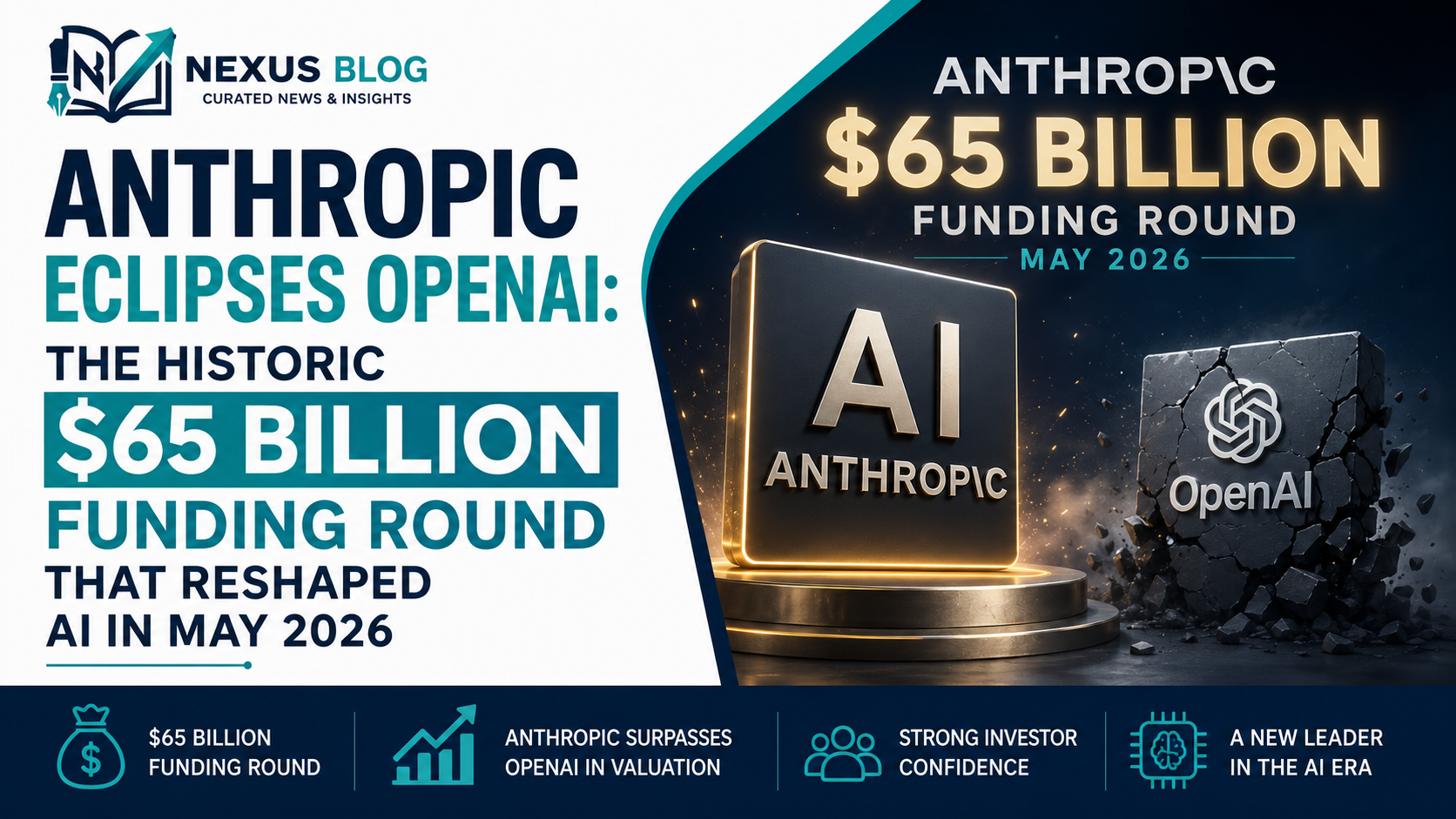
The tectonic plates of the global technology sector have experienced a seismic shift this week. In what is undoubtedly the most monumental artificial intelligence news of May 2026, Anthropic PBC has officially eclipsed its chief rival, OpenAI, in market valuation. Late Thursday, reports confirmed that the San Francisco-based AI research laboratory successfully closed a staggering $65 billion funding round, catapulting its total valuation to an eye-watering $965 billion. This historic financial milestone effectively crowns Anthropic as the most valuable private AI company in the world. The mega-round was heavily backed by a consortium of elite venture capital powerhouses, including Altimeter Capital, Dragoneer, Greenoaks, and Sequoia Capital, with each lead investor pouring in excess of $2 billion. Furthermore, existing strategic partners doubled down on their commitments; Alphabet Inc.’s Google contributed several billion dollars as part of a pre-existing long-term pledge, while Amazon.com Inc. injected an additional $5 billion. In a fascinating geopolitical twist, South Korean semiconductor giants Samsung Electronics and SK Hynix also joined the strategic investment round, underscoring the deep, inextricable link between frontier AI software development and the global hardware supply chain. For the tech industry, this unprecedented influx of capital signifies a definitive turning point, proving that enterprise confidence has firmly gravitated toward Anthropic's safety-first, highly capable architecture.
The timing of this record-breaking valuation is no coincidence, arriving just 48 hours after Anthropic unleashed its latest frontier model, Claude Opus 4.8, on May 28, 2026. While the broader AI market spent April and May flooded with new releases from competitors—including OpenAI's GPT-5.5 updates and an onslaught of powerful open-weight models from Chinese labs like DeepSeek and Moonshot—Anthropic has steadily captured the lucrative enterprise sector by consistently delivering unmatched reliability. Opus 4.8 builds aggressively on the foundation of Opus 4.7, showcasing dramatic improvements in coding, agentic skills, and complex reasoning tasks. With enhanced features like elevated visual acuity (processing up to 3.75 megapixels) and strict automated cybersecurity safeguards, Claude has rapidly become the de facto operating system for major corporate integrations. For example, earlier this month, PwC announced a massive strategic alliance to roll out Claude Code and Cowork to hundreds of thousands of its global professionals. Investors are no longer merely funding theoretical research; they are pouring billions into Anthropic because the company has successfully proven it can deploy scalable, highly secure AI agents capable of executing autonomous, multi-step workflows within the strict compliance boundaries of Fortune 500 companies. This sharp focus on enterprise utility and safety protocols is exactly what has allowed Anthropic to command a near-trillion-dollar premium over OpenAI.
This colossal $65 billion war chest will fundamentally alter the trajectory of the ongoing AI arms race, primarily by allowing Anthropic to secure the massive computational infrastructure required for the next leap toward Artificial General Intelligence (AGI). Training frontier models in late 2026 demands an astronomical amount of processing power, and the inclusion of hardware titans like Samsung and SK Hynix in this funding round highlights a strategic push toward deep vertical integration. Anthropic is not just buying cloud credits; it is actively shaping the global silicon ecosystem. By forging direct financial ties with the world's leading memory chip manufacturers, the company is ensuring it remains at the absolute front of the line for the next generation of high-bandwidth memory (HBM) required to run massive AI accelerators. This move comes at a critical juncture as the broader tech hardware market evolves, with companies like TSMC facing fierce competition and heavy demand for advanced packaging technologies. With $65 billion in fresh capital, Anthropic is perfectly positioned to aggressively expand its proprietary compute clusters, outbid competitors for top-tier engineering talent, and accelerate the development of its highly anticipated next-generation architecture. The sheer scale of this investment guarantees that the speed of AI innovation will not plateau; instead, it is about to enter an exponential hyper-growth phase.
For business leaders, software developers, and tech entrepreneurs, the crowning of Anthropic as the valuation king on May 30, 2026, offers a crystal-clear mandate: the era of relying on a single AI provider is officially over. The market has decisively validated a multi-polar AI ecosystem. While OpenAI's ChatGPT remains a dominant force in consumer applications—having just updated its GPT-5.5 Instant model to serve as its default engine—the enterprise and infrastructural battleground is increasingly leaning toward Claude. Startups and enterprise CTOs must now adopt a flexible, model-agnostic approach to their tech stacks, ensuring they can seamlessly route workloads between OpenAI, Anthropic, and rapidly advancing open-source models like DeepSeek V4-Pro. As we move into the second half of 2026, the ripple effects of this historic $965 billion valuation will be felt across every sector. We will witness an acceleration in AI-driven corporate transformations, deeper integration of autonomous agentic workflows, and a relentless push toward solving the physical hardware constraints of data centers. Anthropic's monumental triumph this week is not just a victory for a single company; it is the loudest signal yet that the artificial intelligence revolution has matured from a speculative novelty into the foundational infrastructure of the future global economy.