 By
By - 277


Business
As we progress through 2026, the initial corporate infatuation with cloud-only artificial intelligence has hit a brutal financial and regulatory brick wall. Mid-market enterprises and data-sensitive organizations that rushed to integrate foundational APIs from OpenAI, Anthropic, or Google into their daily operations are now facing astronomical monthly compute bills alongside severe anxieties regarding data privacy and compliance. Sending millions of tokens of highly confidential customer data, internal financials, and intellectual property to remote cloud servers is no longer a viable long-term strategy. This stark operational reality has triggered a massive, high-demand gold rush for a brand-new B2B consulting model: the Local AI Implementation Agency. These specialized infrastructure firms do not build generic software wrappers; instead, they audit a company's internal data architecture and build bespoke hybrid cloud-to-edge ecosystems. By capitalizing on recent hardware breakthroughs—such as ultra-efficient edge servers and dedicated local AI processors—these agencies allow enterprises to retain complete physical control over their sensitive workloads while keeping operational efficiency at an all-time high.
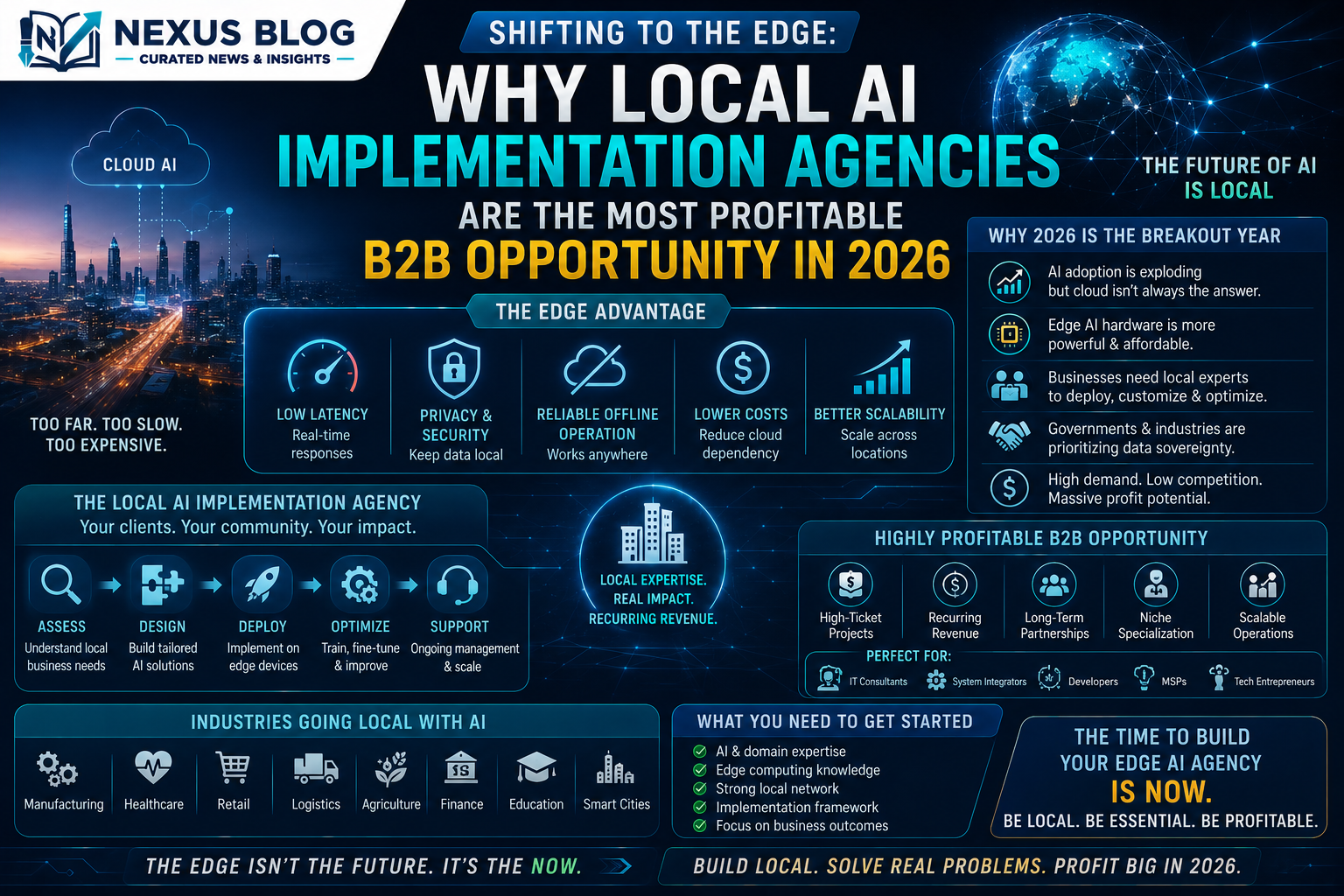
To understand why enterprise buyers are eagerly paying six-figure retainers for these integration services, it helps to look at the distributed topology of a modern hybrid AI infrastructure. Rather than routing every simple text summarization or customer support interaction to the cloud, local AI implementation agencies design a smart, multi-tiered routing framework that dynamically processes workloads based on complexity, security needs, and token costs. As illustrated in the edge computing layout below, data is seamlessly managed across distinct layers: the local user device, regional edge data centers, and centralized hyper-scale clouds.
This hybrid approach ensures that immediate, low-latency tasks are executed close to the source of data generation, keeping internal records fully isolated from external networks. When an agency implements this architecture, they deploy an automated data-routing pipeline that executes systematically across the following distinct phases:
The Hybrid AI Deployment Roadmap
1.Infrastructure Audit and Local Silicon Profiling:Phase 1.
The agency maps out the company's internal data pipelines and assesses local hardware capacities, provisioning local workstations or dedicated on-premise edge servers with fine-tuned Small Language Models (SLMs).
2.Bespoke Semantic Routing and Guardrail Deployment:Phase 2.
Engineers build a specialized gateway layer that acts as an intelligent traffic controller, analyzing incoming prompt intent to see if it can be resolved locally or requires external scaling.
3.Local Context Aggregation and Edge Inference:Phase 3.
Routine tasks, sensitive internal document searches, and compliance checks are routed directly to the on-premise SLMs, bypassing external networks and executing with near-zero latency.
4.Dynamic Cloud Orchestration and Secure Failover:Phase 4.
If a query requires massive processing power or highly specialized reasoning, the gateway encrypts non-sensitive metadata and routes the request to an enterprise cloud model, synthesizing the final result securely.
Macroeconomics of the Edge: Shifting to local hybrid computing isn't just about cutting software overhead; it is an absolute necessity for data gravity and corporate survival in an era where cloud data centers are facing severe energy grid constraints.
The immense profitability of this business model is heavily accelerated by the rapid maturity of open-source Small Language Models (SLMs) like Llama 3.1 8B, Phi-3, and specialized Mistral variants. In 2026, these compact models possess the raw cognitive capability to match or outperform older, massive cloud models on highly specialized corporate tasks—provided they are correctly quantized, embedded, and fine-tuned on a company's internal knowledge base. Local AI integration agencies utilize advanced quantization techniques to compress these models, allowing them to run flawlessly on local consumer-grade hardware or internal server racks powered by dedicated local hardware like Nvidia’s latest chip architectures. When presenting this service to a Chief Financial Officer or Chief Information Officer, the return on investment is immediately clear and easily quantifiable. By shifting up to 70% of a company’s routine reasoning workloads away from recurring API calls and onto their own local electricity and hardware assets, these agencies routinely slash monthly software operational costs by 40% to 60%.
Architecture Comparison Matrix
| Metric | Pure Cloud AI Architecture | Hybrid Cloud-to-Edge AI |
| Average Latency | 1,200ms - 3,500ms (Internet-dependent) | 50ms - 300ms (Localized execution) |
| Data Privacy Risk | High (Third-party server transmission) | Zero for local tiers (On-premise isolation) |
| Scalability Cost | Linear inflation (More prompts = higher bills) | Fixed capital expenditure (Leverages owned hardware) |
| Offline Functionality | Total operational failure if internet drops | Continuous operation for localized workflows |
Ultimately, launching a local AI implementation agency positions your business at the center of the largest infrastructure migration of the late 2020s. As enterprise leaders realize that running autonomous corporate software solely on third-party clouds is financially unsustainable and legally risky, they will gladly invest in teams that can build an independent, unassailable on-premise technological moat. By acting as a trusted hardware and software architect who knows exactly how to slice up large models, optimize local silicon, and construct secure semantic routers, your agency can secure highly sticky enterprise contracts that evolve far past basic software setup into permanent, high-value infrastructure management partnerships.