 By
By - 447


Tech Innovations
The Catalyst for the Agentic AI Paradigm
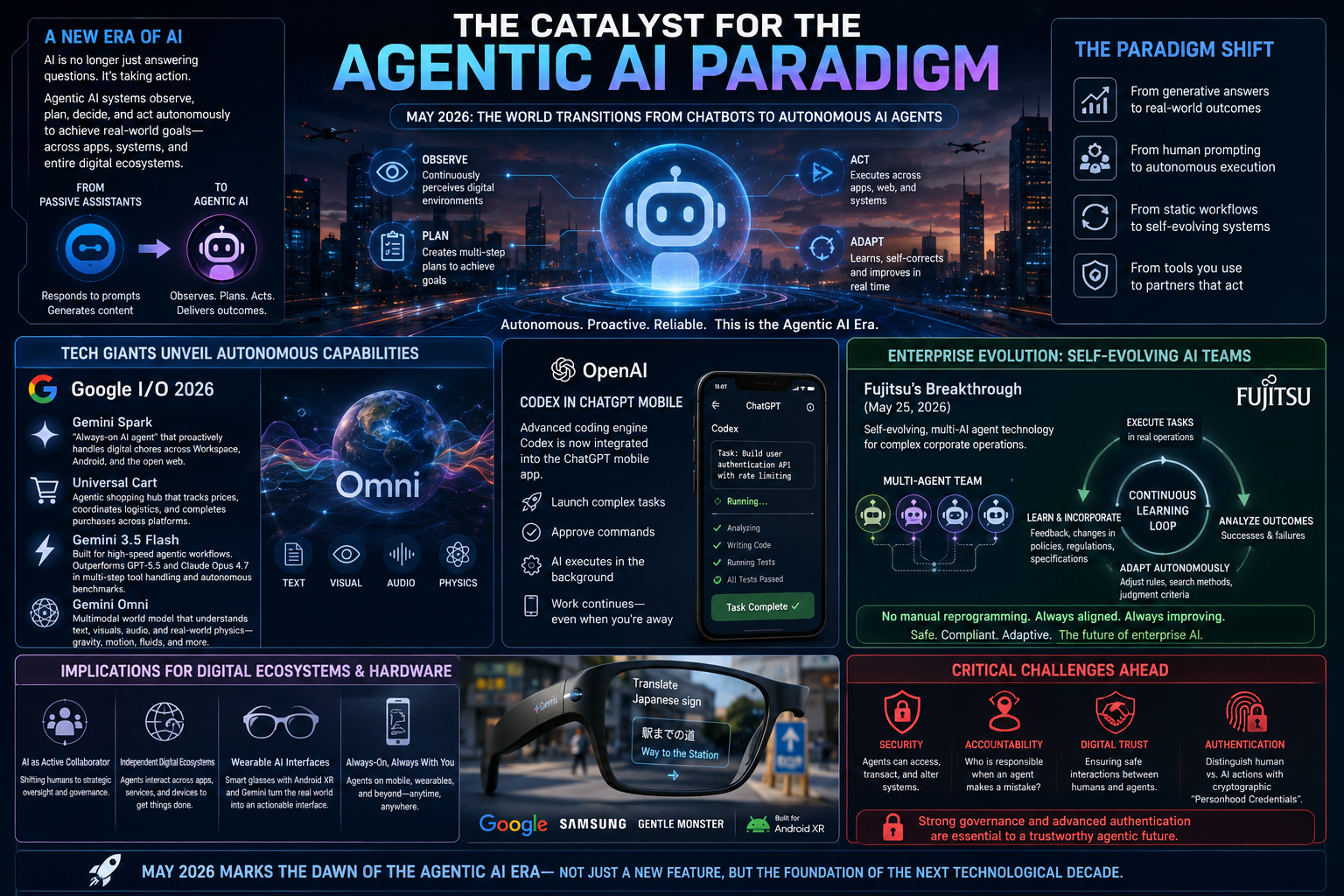
In late May 2026, the artificial intelligence landscape experienced a fundamental paradigm shift as the industry definitively transitioned from conversational chatbots to autonomous, action-oriented "AI agents." This evolution, officially branded by industry leaders as the "Agentic AI Era," marks a sharp departure from generative systems that merely answer user queries to autonomous software entities capable of independently executing complex, multi-step workflows. For the past several years, large language models (LLMs) excelled at generating text, code, and media, but they fundamentally operated as passive assistants requiring constant human prompting. The new generation of agentic AI changes this dynamic. By continuously observing their digital environments, formulating multi-step plans, and taking decisive actions to achieve specific goals, these systems can seamlessly interact with existing software, manage applications, and self-correct errors in real-time. This structural pivot is poised to fundamentally alter how everyday users and large-scale enterprises engage with digital infrastructure.
Tech Giants Unveil Autonomous Capabilities
The most visible catalyst for this month's widespread agentic pivot occurred at Google I/O 2026, where the tech giant unveiled a sweeping lineup of systems designed to push AI beyond the chat box. Central to this was the introduction of Gemini Spark, an "always-on AI agent" engineered to proactively handle digital chores on a user's behalf across Workspace, Android, and the open web. Google also showcased Universal Cart, an agentic shopping hub that autonomously tracks pricing, coordinates logistics, and executes purchases across diverse e-commerce platforms. Powering these features is Gemini 3.5 Flash, an AI model specifically optimized for high-speed agentic workflows that reportedly outperforms rival frontier models like GPT-5.5 and Claude Opus 4.7 in multi-step tool handling and autonomous benchmarks.
Google also pushed the boundaries of AI comprehension with Gemini Omni, a multimodal "world model" that merges text, visual, and audio data to understand real-world physics—such as gravity, motion, and fluid behavior. Not to be outpaced, OpenAI concurrently made massive strides in persistent AI capabilities. The company recently integrated its advanced coding engine, Codex, directly into the ChatGPT mobile application. This integration allows software developers to launch complex programming tasks and approve system commands straight from their smartphones. The AI autonomously manages workflows and executes code in the background, ensuring uninterrupted productivity even when the user's primary workstation is offline.
Enterprise Evolution and Self-Evolving Teams
Beyond consumer applications, the enterprise sector is witnessing an equally transformative leap in agentic capabilities, heavily emphasizing safety and continuous learning. On May 25, 2026, Fujitsu announced a major breakthrough with the development of a self-evolving, multi-AI agent technology designed specifically for highly complex corporate operations. Historically, integrating AI into corporate environments has been bottlenecked by the need for continuous human oversight. Because corporate policies, legal compliance, and system specifications change constantly, conventional AI models required expert engineers to manually adjust prompts, search parameters, and evaluation criteria to prevent critical operational errors.
Fujitsu’s newly unveiled framework solves this by allowing multiple specialized AI agents to collaborate as a unified team. These digital entities possess the ability to safely learn from daily execution outcomes, human feedback, and real-time specification changes without requiring human-led reprogramming. As they perform tasks, the agents autonomously analyze the precise reasons for both their successes and failures, extracting actionable operational insights. Instead of merely logging error reports or generating improvement proposals for humans to review, these multi-agent systems dynamically adjust their own operating rules, search methods, and judgment criteria. This ensures that the AI framework remains aligned with the latest business environments and regulatory shifts, representing a monumental leap in the deployment of reliable, self-governing enterprise software.
Implications for Digital Ecosystems and Hardware
The implications of this agentic shift extend far beyond incremental productivity gains, signaling the dawn of a digital ecosystem where software acts independently. As AI systems evolve from passive tools to active collaborators, the role of human workers will increasingly shift toward strategic oversight and high-level governance. The physical hardware supporting these technologies is also adapting to facilitate seamless agentic interaction. For instance, the integration of these agents into wearable technology—highlighted by the newly announced AI-powered smart glasses developed by Google, Samsung, and fashion brands like Gentle Monster—transforms the physical world into an actionable interface. Equipped with Android XR and continuous agentic AI via Gemini, these devices act as visual and auditory conduits, translating real-world environments and executing tasks hands-free.
However, the delegation of agency to software brings critical challenges regarding security, accountability, and digital trust. As agents autonomously negotiate purchases, deploy code, and alter corporate systems, the industry faces an urgent need for robust regulatory oversight and advanced authentication frameworks—such as cryptographic "Personhood Credentials"—to securely distinguish human actions from autonomous AI operations. Ultimately, the announcements of May 2026 have cemented agentic AI not merely as a theoretical concept, but as the foundational architecture of the next technological decade.