 By
By - 307


Business
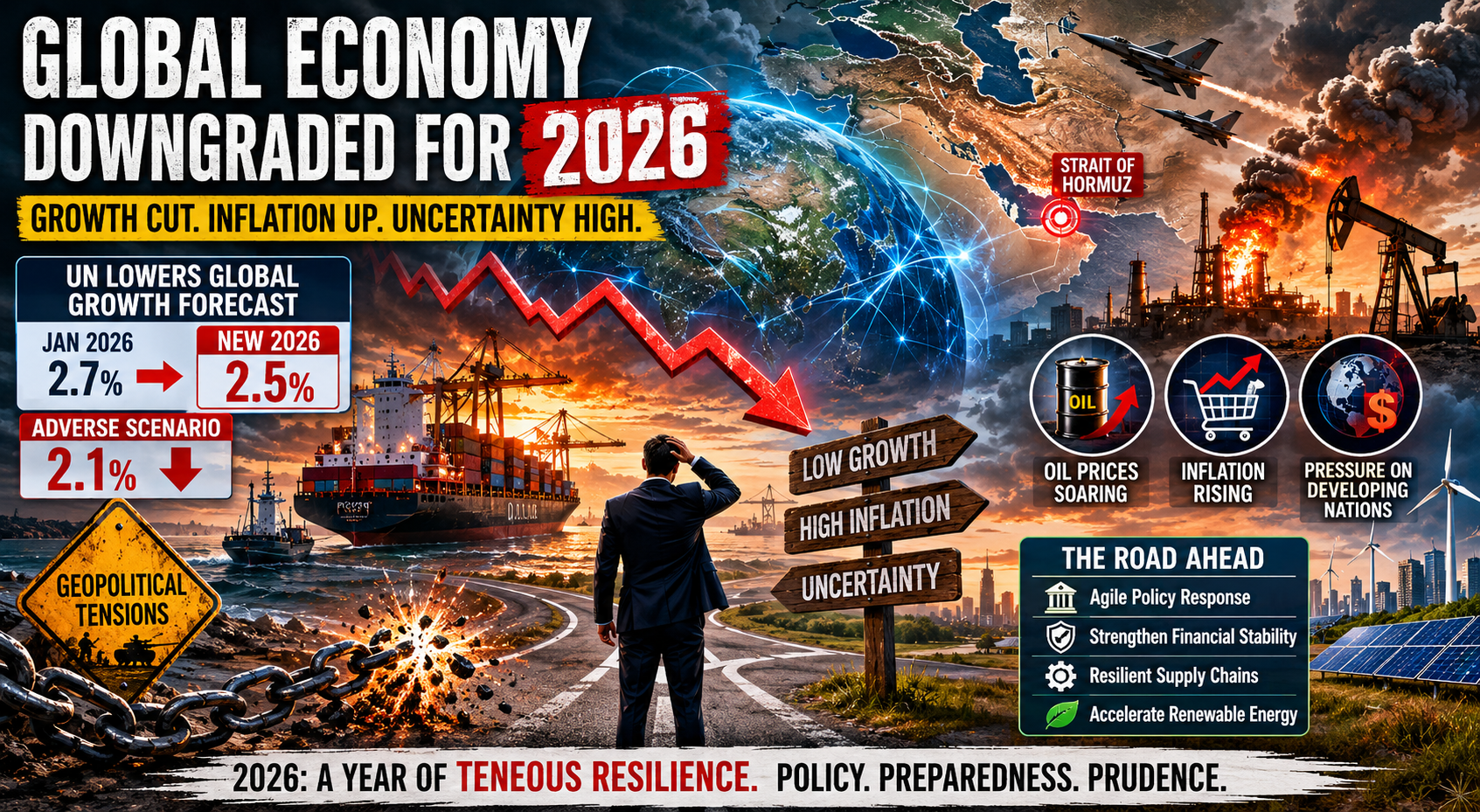
The global economic landscape faces renewed headwinds as the United Nations officially downgraded its global growth forecast for 2026, signaling a tenuous period ahead for international markets and monetary policy. In a stark revision announced recently, the UN Department of Economic and Social Affairs (DESA) lowered its baseline projection for global gross domestic product (GDP) growth to 2.5 percent for the current year, a noticeable drop from the 2.7 percent forecast issued just months earlier in January. More concerning is the introduction of a "more adverse scenario" by UN economists, which suggests that if current geopolitical and supply chain pressures persist, global growth could plummet to a mere 2.1 percent. Shantanu Mukherjee, director of economic analysis at DESA, emphasized the gravity of this trajectory during a recent news conference, noting that such an outcome would represent one of the weakest global economic performances of the 21st century, surpassed only by the deep contractions experienced during the 2008 global financial crisis and the height of the COVID-19 pandemic. This downward revision underscores the fragility of the post-pandemic recovery and highlights how rapidly shifting geopolitical dynamics can upend macroeconomic stability, forcing policymakers and investors to rapidly recalibrate their expectations for the remainder of the year.
The primary catalyst for this deteriorating economic outlook is the severe escalation of geopolitical conflict in the Middle East, which has triggered a profound energy crisis and disrupted critical global trade arteries. Following recent military engagements in the region, including airstrikes involving the United States and Israel, retaliatory measures led to the strategic blocking of the Strait of Hormuz. As one of the world's most vital maritime chokepoints, the closure has choked off the transit of essential commodities, including crude oil, natural gas, refined petroleum products, and agricultural fertilizers. Mukherjee described the situation not merely as a localized blow to energy markets, but rather as a broader supply shock of uncertain scope, magnitude, and duration that is rippling across the world. The sudden restriction of energy supplies has sent crude prices soaring, injecting immense volatility into financial markets that were already grappling with tight financial conditions. Because energy is a foundational input for virtually all sectors of the global economy, this supply bottleneck is heavily impacting industrial production capacities and commercial transport networks globally. Companies reliant on stable energy and shipping routes are now facing surging operational costs, which threaten to compress corporate margins and dampen industrial output across manufacturing hubs in both the East and the West.
Consequently, the disruption in energy markets has reignited fears of sticky global inflation, effectively erasing the disinflationary progress celebrated by central banks late last year. The UN has revised its global inflation projection upward to 3.9 percent for 2026, marking a significant 0.8 percent increase from its January estimates. However, the burden of this inflationary resurgence is not distributed equally, revealing a stark divergence between advanced and emerging economies. In richer, developed nations, inflation is expected to see a moderate uptick, moving from an anticipated 2.6 percent to 2.9 percent. While this complicates the monetary policy pivot for institutions like the Federal Reserve and the European Central Bank—likely delaying anticipated interest rate cuts—these economies possess stronger buffers to absorb the shock. Conversely, developing nations are bearing the brunt of the crisis. Inflation in these regions is forecast to accelerate sharply to 5.2 percent, driven by the escalating costs of imported fuel, essential goods, and transportation. For these vulnerable economies, surging inflation directly erodes real incomes, exacerbates food insecurity, and drains foreign exchange reserves. The compounded pressure of higher import bills and restrictive global borrowing costs places immense strain on developing nations, raising the specter of sovereign debt distress and widening the economic inequality gap on a global scale.
Looking forward, the global economic trajectory will depend heavily on the duration of the Middle East crisis and the agility of domestic policy responses. The UN's baseline forecast relies on the critical assumption that oil prices will begin to moderate in the second half of 2026 and that governments will proactively mitigate the immediate energy shock by tapping into strategic fuel reserves. However, if the conflict prolongs or expands, the adverse scenario of 2.1 percent growth becomes increasingly probable. Policymakers are now navigating a complex trilemma: attempting to stimulate sluggish growth, contain supply-driven inflation, and preserve financial stability amid heightened geopolitical uncertainty. For the business sector, this environment necessitates rigorous risk management and a strategic reevaluation of supply chain dependencies. Multinational corporations are likely to accelerate the reshoring or nearshoring of critical operations to insulate themselves from future maritime chokepoint vulnerabilities. Furthermore, as the world confronts the immediate fallout of fossil fuel dependency, the crisis may inadvertently act as a catalyst for accelerating investments in renewable energy infrastructure and energy efficiency technologies. Ultimately, 2026 is shaping up to be a year defined by tenuous resilience, where the interplay between geopolitical shocks and macroeconomic policy will dictate whether the global economy can avoid a broader recessionary spiral.