 By
By - 285


War News
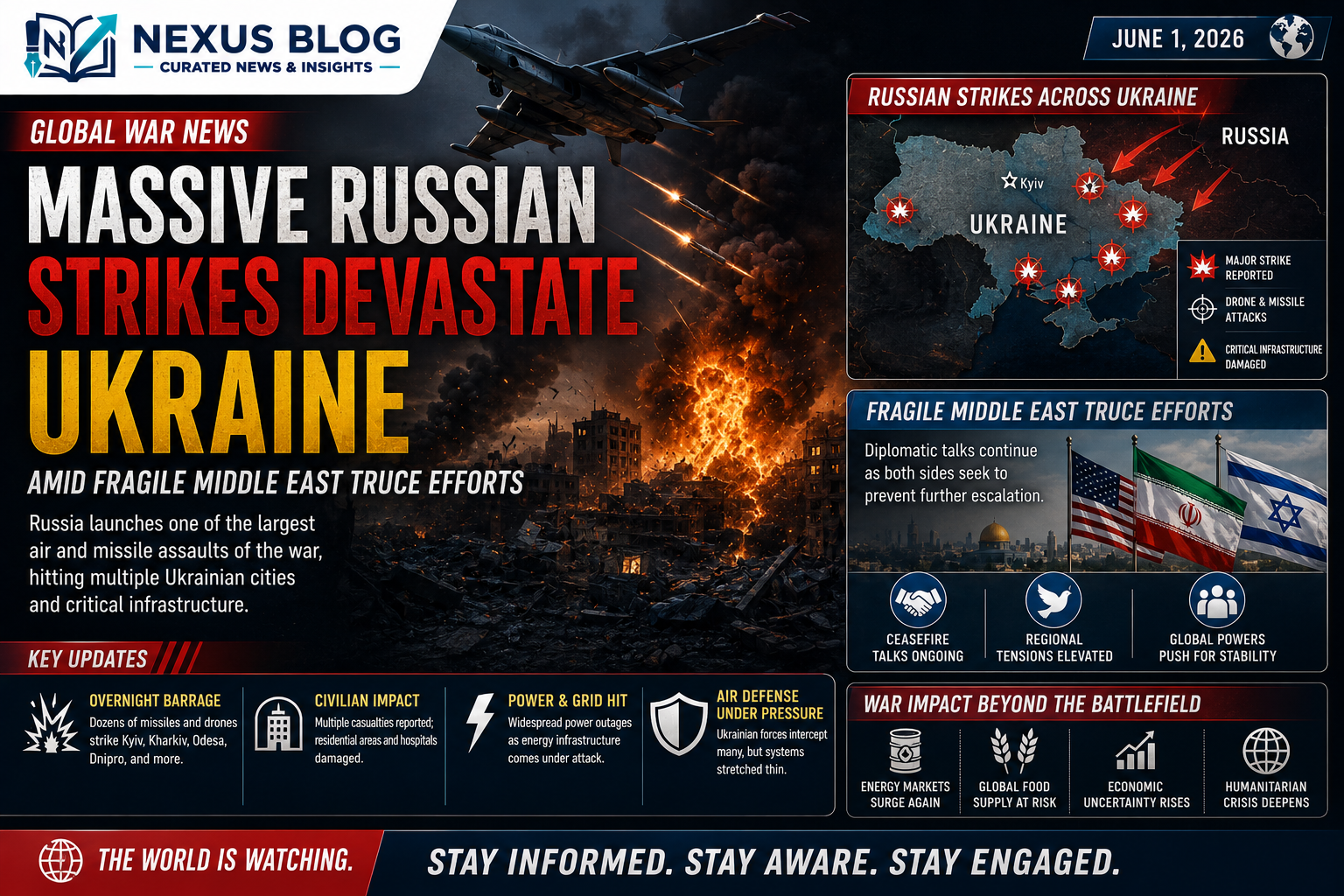
The war in Ukraine has entered a deadly new phase as of June 2, 2026, following a massive and devastating Russian missile and drone barrage that struck multiple cities overnight. Ukrainian authorities reported that Moscow launched over 650 drones and dozens of ballistic and hypersonic missiles, targeting critical infrastructure and civilian areas. The capital city of Kyiv bore the brunt of the assault, with Mayor Vitali Klitschko confirming multiple fatalities and dozens of injuries after ballistic missiles breached air defenses, setting residential buildings ablaze and cutting power across several districts. The relentless bombardment also struck the eastern cities of Dnipro and Kharkiv, leading to further tragic civilian casualties, including emergency responders who were hit in secondary strikes. This catastrophic wave of attacks comes just days after Ukrainian President Volodymyr Zelenskyy issued a stark warning that Russian forces were preparing a "massive new strike." In response to the carnage, President Zelenskyy has renewed his urgent pleas to the United States Congress and President Donald Trump, requesting immediate authorization and financing for additional Patriot air defense systems capable of intercepting Russian ballistic threats. As the deadliest European conflict since World War II drags on, the staggering human toll and the ongoing destruction of Ukraine's military-industrial complex underscore the urgent need for robust international support, especially as diplomatic efforts to negotiate an end to the war remain entirely stalled.
While Eastern Europe burns, the geopolitical focus in the Middle East remains dangerously volatile, despite sudden and highly publicized diplomatic interventions. On Monday evening, U.S. President Donald Trump announced that a significant breakthrough had been achieved, claiming that he successfully persuaded Israeli Prime Minister Benjamin Netanyahu and the Lebanese militant group Hezbollah to agree to a mutual halt in hostilities. According to Trump’s statements, Israel has called off a planned military raid on Beirut, and Hezbollah has committed to stopping all cross-border shooting, effectively averting a full-scale invasion of southern Lebanon that threatened to plunge the entire region into an irreversible war. However, the broader diplomatic landscape involving Iran remains on a knife-edge. Tehran’s chief negotiator warned that Iran could permanently halt all ceasefire negotiations with the United States if Israeli military operations in Lebanon continue to violate established red lines. This diplomatic deep freeze follows a rapid and alarming exchange of overnight strikes between U.S. forces and Iranian military bases earlier in the week. The Revolutionary Guards have further escalated the rhetoric, threatening to activate allied fronts and block the highly strategic Strait of Hormuz if their demands are not met. Consequently, global oil markets are experiencing massive intraday volatility, as traders weigh the potential for a catastrophic supply shock against the fragile promises of an American-brokered truce.
Beyond the primary theaters of Ukraine and the Middle East, a deeply concerning escalation in violence is rapidly unfolding in Africa, specifically within Sudan's war-torn Darfur region. Local sources and human rights observers reported on June 2 that a devastating long-range drone strike struck a crowded marketplace and a rural hospital in the town of Kubum, located in South Darfur. This horrific aerial attack resulted in multiple civilian casualties and has massively intensified the ongoing, bloody tribal warfare between the Salamat and Beni Halba ethnic factions. Both of these powerful tribes had previously pledged allegiance to the Rapid Support Forces (RSF), and local medical officials treating the wounded have openly accused the RSF of orchestrating the drone strike from Nyala to provide tactical air support to one of the warring groups. The strike coincided with brutal ground assaults, with armed militias setting fire to Kubum and the neighboring town of Markundi, forcing thousands of civilians to flee their homes under grueling humanitarian conditions. As aggressive tribal mobilization campaigns gain traction near the border of the Central African Republic, international observers are sounding the alarm that this localized ethnic violence could rapidly spill over, destabilizing the entirety of Central Darfur State and exacerbating one of the world's most severe, yet underreported, humanitarian crises.
As the international community grapples with the events of June 2, 2026, it is abundantly clear that the global security architecture is facing unprecedented, simultaneous stress tests across multiple continents. The sheer scale of the Russian bombardment in Ukraine highlights a chilling reality: as the United States and its Western allies redirect massive diplomatic capital and military resources to contain the explosive situation in the Middle East, critical defense gaps are being mercilessly exploited by Moscow. Furthermore, the introduction of advanced drone warfare into tribal conflicts in Sudan demonstrates how modern military technology is proliferating into the hands of paramilitary factions, exponentially increasing the lethality of localized disputes. World leaders are now forced to navigate a deeply fractured geopolitical environment where a fragile, unconfirmed ceasefire in Lebanon can instantly dictate the price of global energy, and where the lack of air defense systems in Kyiv translates to devastating daily civilian losses. As U.S. Secretary of State Marco Rubio prepares to testify before Congress regarding the stalling diplomatic efforts with Iran, the world watches with bated breath, fully aware that the interconnected nature of these global conflicts requires a unified, resolute international response to prevent a total collapse of global stability.