 By
By - 1426


Business
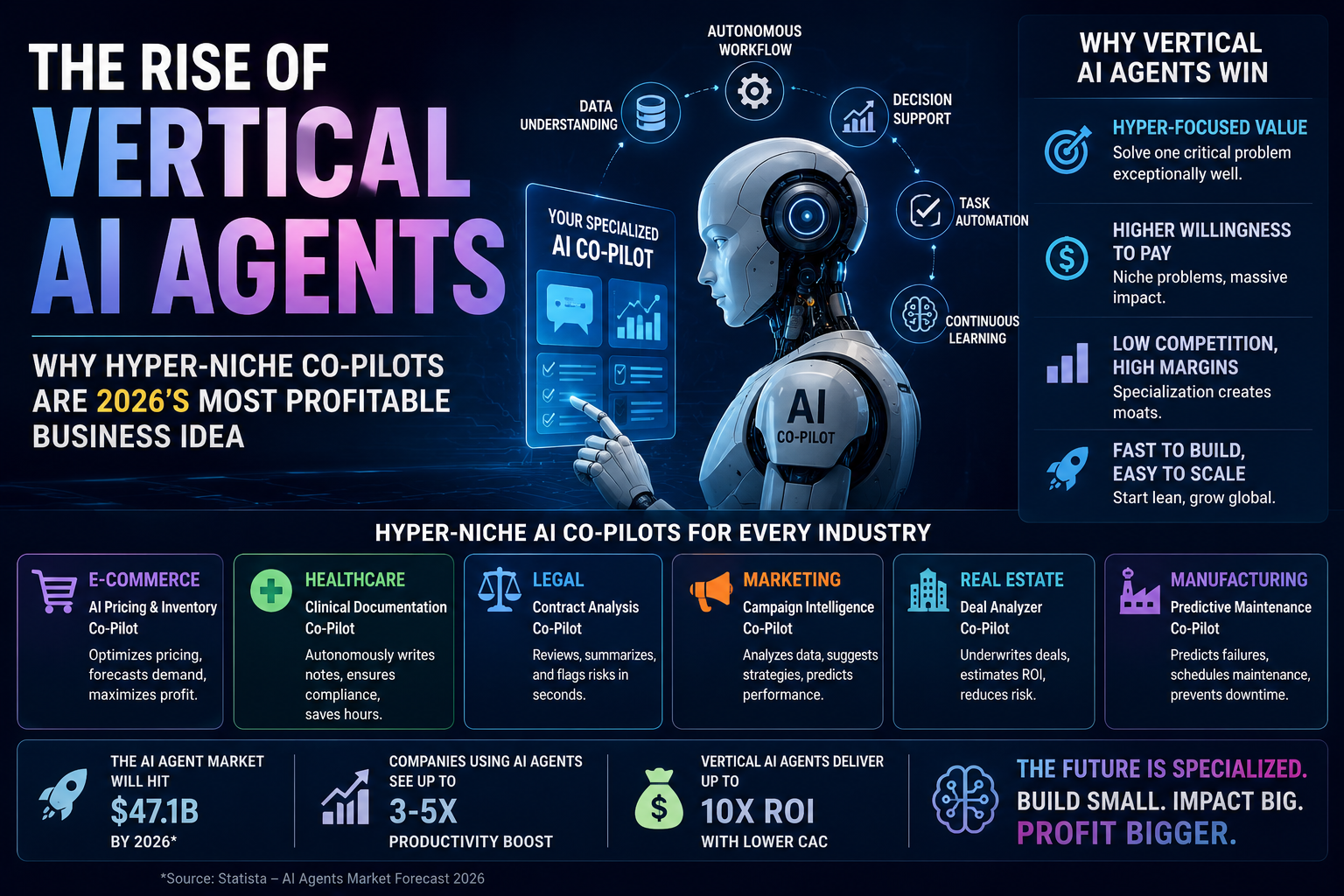
Late May 2026 has marked a definitive, undeniable turning point in the global artificial intelligence landscape, officially closing the chapter on generic, consumer-facing "ChatGPT wrappers" and ushering in the highly lucrative era of Vertical AI Agents. The catalyst for this monumental industry shift arrived this week with two massive corporate announcements that double as a flashing neon blueprint for aspiring entrepreneurs. First, tech giants IBM and Red Hat unveiled "Project Lightwell," a staggering $5 billion commitment combining over 20,000 engineers with advanced AI capabilities to secure and optimize open-source software supply chains. Almost simultaneously, KPMG announced the largest Big Four AI rollout in history, deploying Anthropic’s frontier AI model, Claude, directly into the core workflows of its entire global workforce of 276,000 professionals. These colossal enterprise investments underscore the top new AI business idea for 2026: hyper-niche, industry-specific Vertical AI Agents. Rather than attempting to build all-knowing, generalized chatbots that compete directly with multi-billion-dollar tech conglomerates, the most profitable and secure avenue for today's startup founders is developing highly specialized AI copilots. The global market has definitively spoken this month—businesses are no longer paying for novelty or broad capabilities; they are eager to pay a premium for precision. They want bespoke AI solutions that seamlessly integrate into their existing platforms to solve granular, industry-specific pain points significantly faster and more accurately than human-only workflows ever could.
So, what exactly constitutes a Vertical AI Agent, and why is it currently dominating the 2026 startup ecosystem? A Vertical AI Agent is an advanced artificial intelligence system trained extensively on the proprietary data, strict compliance rules, and specific operational nuances of a single, defined industry—such as legal client intake, medical scribing, construction project management, or specialized corporate bookkeeping. Unlike a broad foundational model that simply retrieves information, a vertical agent acts as an autonomous digital employee capable of executing complex, multi-step workflows. For instance, consider an AI medical scribe built exclusively for dermatologists. It does not merely transcribe a patient consultation; it instantly structures the raw audio into EHR-ready clinical notes, correctly assigns complex ICD billing codes, and flags potential drug interactions without human prompting. The business case for these hyper-focused tools is incredibly compelling because they offer an immediate, measurable return on investment for small to mid-sized businesses (SMBs). An AI sales copilot that automatically researches prospects, drafts hyper-personalized outbound outreach, and dynamically updates a niche Customer Relationship Management (CRM) platform can effectively replace the need for an entire entry-level sales development team, saving a company tens of thousands of dollars annually. For the modern entrepreneur, the barrier to entry has drastically decreased. The startup costs for these specialized ventures typically range between just $5,000 and $25,000, driven down by the widespread availability of affordable, high-powered API models. Furthermore, operating within a tight, hyper-niche sector significantly reduces the existential threat of competition from major tech monopolies. By focusing intently on a single, traditionally underserved vertical—such as automated inventory forecasting for mid-market e-commerce brands or AI-driven tax preparation for freelance creatives—founders can build massive competitive moats.
Executing on this lucrative business model requires a strategic approach centered heavily on "founder-market fit." The most successful AI startups emerging in late May 2026 are not necessarily founded by traditional software engineers. Instead, they are increasingly being launched by industry insiders—former nurses, paralegals, supply chain managers, or corporate accountants—who partner with technical co-founders to solve the exact operational bottlenecks they personally experienced. To launch your own Vertical AI business, your first crucial step is to identify a manual, high-volume data task within an industry you know intimately. Next, you must relentlessly validate the market demand before writing a single line of code. Because virtually every business in the current economic climate is actively seeking ways to streamline operations, securing early pilot partnerships with local firms is easier than ever. Entrepreneurs can quickly build a core Minimum Viable Product (MVP) using powerful no-code AI builders to demonstrate how their customized tool securely ingests proprietary data and outputs actionable results. Monetization in this specialized B2B space is remarkably profitable. Most Vertical AI startups operate on a Software-as-a-Service (SaaS) subscription model, routinely charging anywhere from $199 to over $2,500 per month depending on the value of the labor replaced, supplemented by usage-based credit tiering for clients requiring higher data volume processing.
As we move deeper into the second half of 2026, the window of opportunity for early movers in the Vertical AI space is rapidly narrowing, but the potential financial upside has never been greater. The corporate appetite for immediate, AI-driven operational efficiency is at an absolute all-time high. By closely observing the massive strategic moves made this month by industry titans like IBM, Red Hat, and KPMG, forward-thinking entrepreneurs have been handed a crystal-clear blueprint for scalable success. The era of broad, generic AI experimentation is officially over. Now is the exact moment to stop marveling at the underlying technology and start building the specialized, niche-driven Vertical AI agents that will inevitably power the future infrastructure of global business.