 By
By - 262


Google Launches Gemma 4 12B to Champion Native Encoder-Free Multimodal Architecture
Tech Innovations
The international technology ecosystem has been completely upended this Friday, June 5, 2026, following a major open-source product release from Google that threatens to reshape the core physics of software development. Dominating the new artificial intelligence introduction news cycle today is the official unveiling of Gemma 4 12B—the world’s first unified, completely encoder-free multimodal open-weight model. For years, developers looking to build highly advanced cross-modal applications had to rely on fragmented, patched-together software pipelines. These legacy systems clumsily stitched independent visual, auditory, and textual models together via complex APIs, resulting in massive processing latency, high computing token overhead, and fragmented operational consistency. Google’s latest architecture completely smashes this structural barrier by delivering a single, highly optimized neural network that natively processes, cross-references, and synthesizes diverse input streams simultaneously. This release signals a massive, calculated offensive to ensure open-source systems remain highly competitive against multi-billion dollar private cloud infrastructure as the industry aggressively pivots from basic prompt engineering into the high-stakes domain of full process ownership.
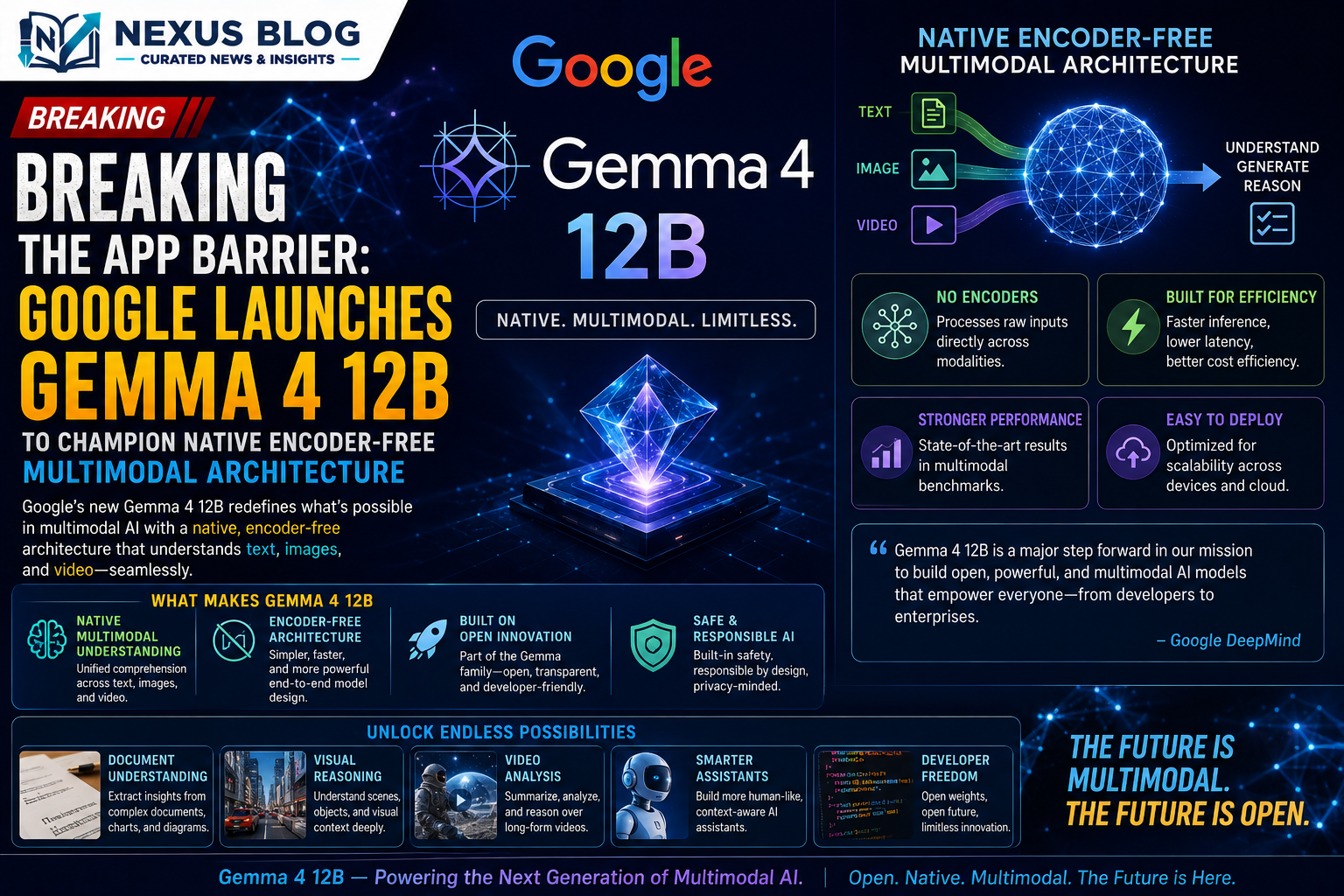
The true engineering masterpiece driving Gemma 4 12B lies within its unique, encoder-free mixture-of-transformers design matrix. As visualized in the architectural concept above, the model bypasses traditional separate processing pipelines entirely. In legacy AI development, an external vision encoder would have to translate an image into math, and a text model would translate a caption, before a third layer finally attempted to reconcile the two. Gemma 4 natively reads text, pixels, ambient sounds, and operational parameters into the same unified token space. This structural simplification allows the 12-billion-parameter engine to deliver unprecedented intelligence-per-parameter, achieving processing efficiency scores that match or exceed closed-source models double its size. When implemented within real-world environments, this seamless cross-modal synergy enables developers to build highly advanced autonomous workflows. To ensure builders can immediately tap into this new level of local computing power, Google has simultaneously initiated an automated deployment roadmap that executes systematically across the following distinct phases:
The Open-Source Multimodal Integration Pipeline
1.Model Provisioning and Local Quantization:Phase 1.
Developers download the unified weights directly via GitHub or Google AI Studio, applying localized quantization layers to compress the model to fit on standard consumer-grade AI workstations.
2.Cross-Modal Context Alignment:Phase 2.
The engine binds live application state data, vision feeds, and textual guidelines into a unified context window, preparing the system for continuous local reasoning.
3.Real-time Unified Inference:Phase 3.
Gemma 4 processes incoming sensory streams simultaneously, executing complex multimodal comprehension, structural code generation, and ambient audio parsing with near-zero network latency.
4.Autonomous Action Prediction and Execution:Phase 4.
Bypassing text-only outputs, the model translates its final reasoning layer directly into precise tool calls, operational UI changes, and automated background script executions.
The Power of Open-Weights: By granting global developers complete access to the raw model weights of a unified multimodal system, Google is effectively democratizing the underlying tools required to build highly secure, on-premise digital assistants that run independently of third-party cloud infrastructure.
The broader economic implications of this June 5th rollout are poised to completely rewrite the operational playbook for tech startups, solopreneurs, and enterprise software engineering teams globally. Historically, building a multi-modal product required an immense amount of venture capital simply to cover soaring cloud API bills from centralized hyper-scalers. By making Gemma 4 completely open-weight, Google has drastically leveled the playing field, enabling smaller, agile teams to build faster, sell faster, and run advanced agentic systems with incredibly thin capital structures. To aggressively capitalize on this structural democratization, Kaggle has concurrently partnered with Google to launch a specialized "AI Agents Vibe Coding Course." This highly anticipated educational initiative is explicitly designed to teach non-traditional programmers how to utilize these unified multi-modal models to build functional, production-ready software systems through natural language intention rather than getting bogged down in traditional, rigid syntax frameworks.
Looking down the road, the commercial arrival of Gemma 4 12B marks a definitive, permanent shift in how humanity will interact with digital computing environments. As enterprise software platforms continue to migrate away from old-school, static application menus toward "just-in-time" generative user interfaces, the demand for models that can fluidly comprehend sight, sound, and text simultaneously will become an absolute prerequisite for market survival. The ultimate competitive moat for future tech innovators will no longer be determined by how well they can write code, but by how effectively they can choreograph these unified, cross-modal neural networks to safely execute real-world enterprise operations. By setting a monumental new open standard for multimodal computing, this landmark release paves the way for an incredibly vibrant, decentralized future where high-performance, completely autonomous digital partners are universally accessible to anyone with a creative concept and the drive to build.